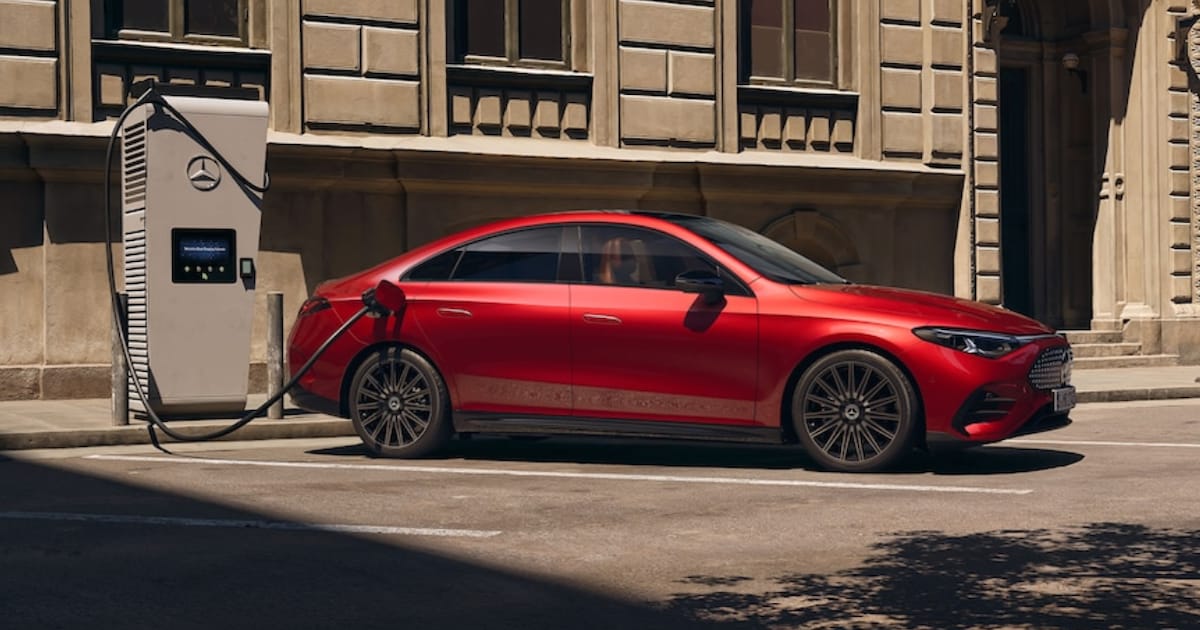
A YouTuber and electric car expert drives the Mercedes CLA 350 4Matic on the highway like a combustion engine. He finds it brutal what this car does on long journeys.
The YouTuber “JÖNOHS” tests purely electric vehicles on his channel. In his current video, he tests the Mercedes CLA, currently the strongest expansion stage in the series. Because his test car is a CLA 350 4Matic, an electric sedan coupé variant with all-wheel drive and an 85 kWh battery.
Officially, Mercedes promises a WLTP range of up to 770 kilometres with the right configuration. In the test car, however, the CLA rolls on 18-inch winter wheels and AMG rims – not the most efficient, but a typical everyday combination. There is also a large trunk for this vehicle class with over 100 litres and a 405-litre trunk with a somewhat impractical, narrow opening and a high loading sill. Inside, Mercedes relies on the familiar cockpit architecture with a large display array, optional passenger screen and head-up display. The material quality is high-quality, the seats are suitable for long journeys, the flat rear footwell and the large glass roof ensure an airy feeling of space, even if it cannot be darkened.
Mercedes CLA on the highway: No consideration for consumption
However, the equipment is less important for this test than the driving style. The YouTuber sets off from home towards Rüsselsheim near Frankfurt with a charge level of 100 per cent. This corresponds to around 380 kilometres of highway; the next day the same route. His approach was to drive an electric car just like a combustion engine. This means no strict limit of 120 or 130 km/h, but rather swimming with the flow of traffic, on free sections also 180 to over 200 km/h, and only as much consideration for consumption as you would with a petrol or diesel engine. It rules out excessively risky driving manoeuvres, but the cruise control is set at up to 210 km/h in places, which the CLA can handle without any problems.
Wind noise through the mirrors and windows only becomes audible from around 170 km/h. Overall, the chassis appears to be comfortably tuned – a classic steel chassis without adaptive dampers, which is still convincing on long journeys.
A clever system ensures optimized driving performance
The integrated navigation initially plans via Stuttgart, but due to a major construction site, the driver decides against this route and switches to an alternative via the A7 and Würzburg. The system continually adjusts the route as it progresses, takes traffic jams and construction sites into account, and at the same time adjusts the range forecast. In addition, the CLA—similar to Tesla—displays recommendations as to the maximum speed at which the driver can reach the destination without stopping to charge. Initially this is 140 km/h, later 130, then 120 km/h. This gives you a feeling for what influence the speed has on the remaining range.
Independent planning of charging stops
Nevertheless, it becomes clear: without recharging, things will be tight on the outward journey. With 38 per cent battery remaining and around 170 kilometres remaining, the system predicts an arrival with only four per cent. Shortly afterwards, the CLA independently plans a stop at an Ionity fast charging station, arriving at around 18 per cent. In the end, the expert arrives at the charging point after almost 300 kilometres with 13 per cent. The values calculated by the vehicle are surprisingly close to reality. The CLA charges to over 40 per cent in just a few minutes, although the distance would actually have only required a charge jump to just under 30 per cent. The car doesn’t achieve the promised maximum charging power of 320 kW that evening—around 220 to almost 300 kW were measured—but the stop is still short and practical: a toilet break, a few minutes at the charger, then we move on.
At the destination hotel, an everyday situation emerges that will be familiar to many electric drivers: the hotel’s parking lot with charging stations is overcrowded, even though the arrival by car was announced. The driver switches to a public charging station one street further. The CLA charges there with a charging card for 0.62 euros per kWh but has to be parked after four hours; otherwise, a blocking fee is due. Overnight it only goes to 75 per cent.
From 10 to 80 percent in 23 minutes
Based on the battery charge for the return journey, the navigation initially plans two short charging stops. The YouTuber is trying to get the system to get by with a single larger stop—also to determine a value close to the standard of 10 to 80 per cent charging stroke. However, the system planning does not allow this, which is why he ultimately selects a charging station manually and arrives with only two per cent remaining range. From 10 to 80 per cent, it takes 23 minutes; the manufacturer states 20 minutes. The charging curve drops noticeably from around 200 kW; at 80 per cent, there is still around 85 kW. Given the 800-volt architecture, this is solid and significantly better than older Mercedes electric models.
The expert sums up: “I’m a bit speechless.”
However, the consumption values on long journeys are really impressive: on the outward journey of almost 388 kilometres, the average was 22.5 kWh per 100 kilometers—at around ten degrees outside temperature, with winter tires and frequent speeds of up to 180 km/h and above. On the return journey, the value even dropped to 21.4 kWh per 100 kilometres, even though a longer section was driven in the rain with less favorable aerodynamic conditions. This average also includes a section of around 70 kilometers on which the driver was traveling almost permanently at full speed: at an average speed of 152 km/h, consumption was 28.6 kWh per 100 kilometres – an exceptionally low value for this speed. Over the entire distance of almost 800 kilometres, the average consumption ultimately settled at exactly 22 kWh per 100 kilometres.
After these almost 800 kilometres in “combustion engine mode”, the expert explains: “I’m a bit speechless.” This describes the efficiency and consumption values of the electric CLA quite accurately on long journeys.
About the Author