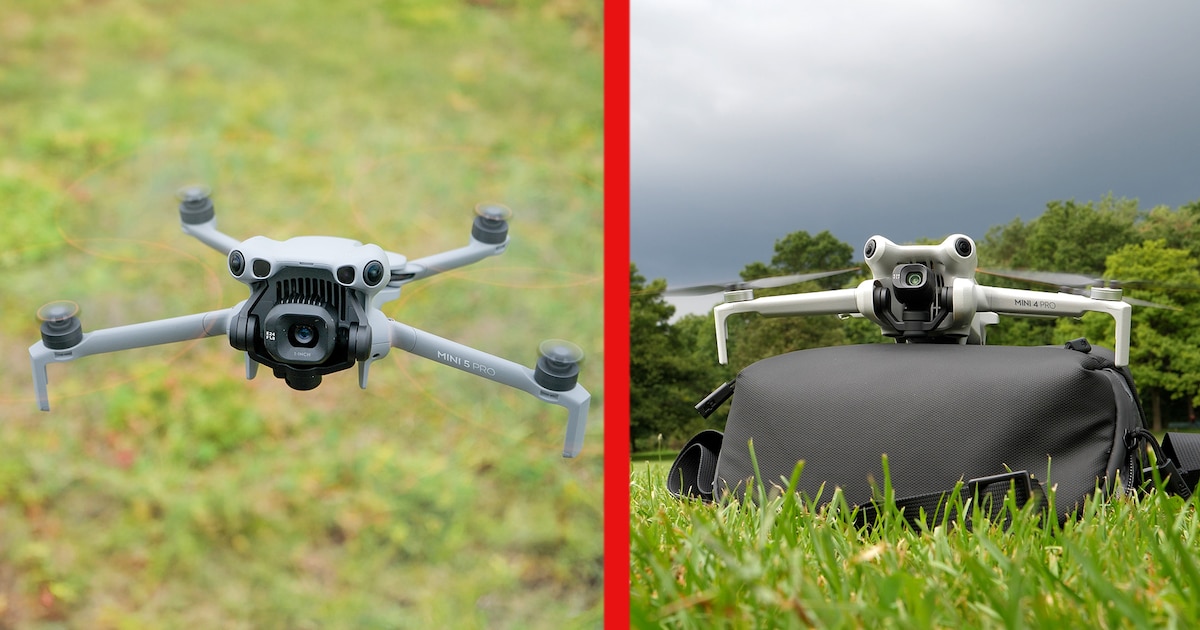
The DJI Mini models have been among the most popular drones for ambitious hobby pilots for years. But do you have to use the more expensive DJI Mini 5 Pro or is the DJI Mini 4 Pro enough? Here we show all the important differences in comparison.
Note: Classification as a price tip or according to price limits is based on the cheapest shop offer in our price comparison; the price in the linked shop may differ.
The DJI drones in the Mini series are very popular because these compact folding drones are technically excellently equipped, but still weigh less than 250 grams. This means: Legally, these models benefit from simplified EU drone rules and no special pilot’s license is required.
The DJI Mini 5 Pro is the successor to the DJI Mini 4 Pro. On paper, the leap compared to its predecessor seems manageable: slightly larger sensor, slightly more megapixels, slightly more performance. But do these improvements actually justify the additional cost? A closer look at the results from the CHIP test center shows where the differences really lie – and for whom the upgrade is worthwhile.
Camera technology: Larger sensor vs. measurable image quality
With the DJI Mini 5 Pro, the manufacturer is using a 1-inch sensor with 50 megapixels for the first time in the Mini series. The DJI Mini 4 Pro, on the other hand, only offers a 1/1.3-inch sensor with 48 megapixels. Both drones film in UHD resolution (3,840 × 2,160 pixels) at up to 60 fps, with the DJI Mini 5 Pro also offering 120 fps (images per second) for UHD slow motion instead of 100 fps like the previous model. This allows for a slightly greater slowdown.
On the data sheet, the camera appears clearly superior to the DJI Mini 5 Pro – especially due to the significantly larger sensor, which theoretically promises advantages in terms of dynamic range and low light. The measurement results from the CHIP test center confirm a significantly higher sharpness in photos; in daylight, the DJI Mini 5 Pro achieves 2,738 line pairs per image height (LP/Bh) in photos, while the DJI Mini 4 Pro only achieves 1,361 LP/Bh. Even in low light, the new model is clearly ahead.
When it comes to video sharpness, however, the difference is smaller: the Mini 4 Pro even achieves a slightly higher 1,021 LP/bh in daylight than the Mini 5 Pro with 989 LP/bh. When it comes to slow motion options, the DJI Mini 5 Pro is ahead.
DJI promises improved noise performance and overall more stable image quality in low light conditions thanks to the Mini 5 Pro’s larger sensor. The measured values support this statement: For low-light videos, the DJI Mini 5 Pro is 1.2 VN1, the Mini 4 Pro is 1.4 VN1. Photos also show a slight advantage for the new model. The difference is not dramatic, but it is visible – especially for users who often fly at dusk or when taking indoor photos.
Now with LiDAR: Current model with even better flight characteristics
Both drones are super easy to fly with the included remote control and the DJI Fly app: They offer an automatic return function, tracking modes and omnidirectional obstacle detection. DJI expands this to five sensors in the DJI Mini 5 Pro with the newly integrated, forward-facing LiDAR, while the Mini 4 Pro makes do with four sensors. The maximum flight speed of the DJI Mini 4 Pro increases to 65 km/h compared to 58 km/h for the previous model.
DJI supplies the DJI Mini 5 Pro with a battery with a higher capacity; as always, specific running times depend on the current wind conditions and personal flying style. In the standardised test, however, the DJI Mini 5 Pro lasted 31 minutes with UHD video, while the DJI Mini 4 Pro only lasted 27 minutes. Even at maximum frame rate, the new model is clearly ahead at 29 minutes. This is a real plus point for longer flight projects or travel missions.
Conclusion: For whom is the surcharge worth it?
The DJI Mini 5 Pro is objectively the better drone: longer battery life, higher-resolution photos, better low-light performance and more reserves for slow-motion video. Anyone who takes photos regularly, films in difficult lighting conditions or wants to get the most out of the mini class will get a more rounded overall package with the new model.
However, the DJI Mini 4 Pro remains a very strong alternative. For hobby pilots, travel vloggers and anyone who primarily films in daylight, it continues to deliver convincing image quality – at a usually cheaper price. Tip: If you have to pay attention to your budget but know that you will be using the drone often and with pleasure, you should consider whether it would be better to save money with the previous model, but then use this one instead Fly More Combo purchased: This means an additional charge of 200 euros, but the top DJI RC 2 remote control is included as well as two replacement batteries for maximum flying pleasure.
About the Author