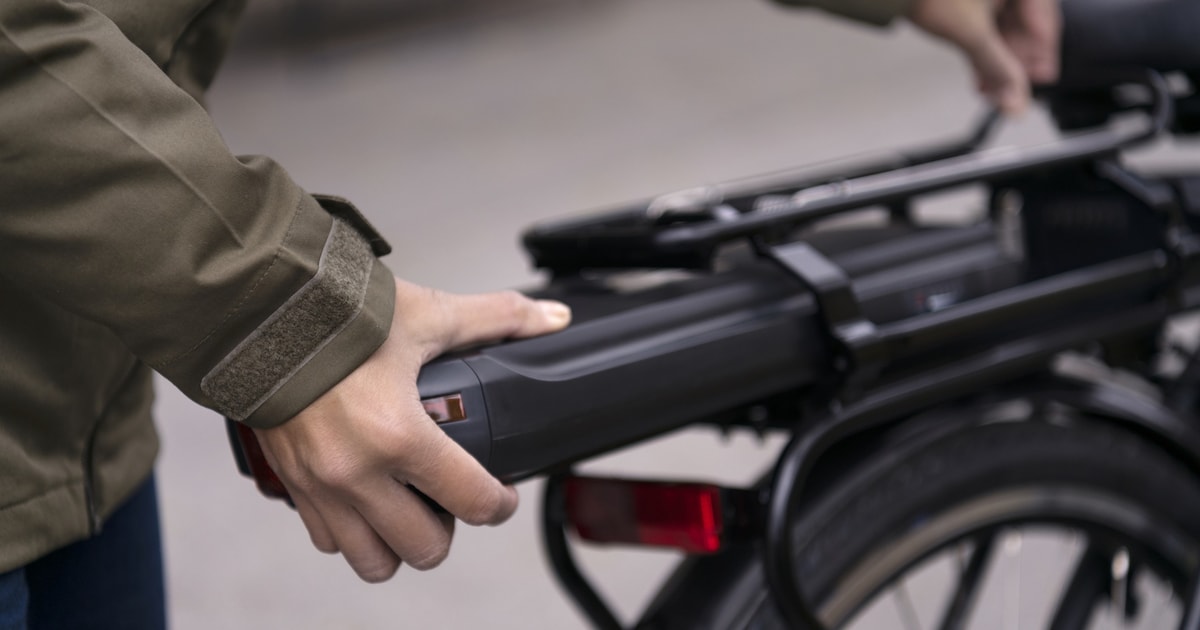
The battery is the heart of every e-bike—and at the same time one of its most expensive components. But what is actually in the mostly black box, how does it work, and what is really important in terms of capacity, range, and service life?
It often sits inconspicuously in the frame or on the luggage rack—and yet it is the heart of every e-bike: the battery. Without it nothing moves, and at the same time, it is one of the most expensive components. What may surprise many people is that despite different designs and manufacturers, modern e-bike batteries are technically very similar.
E-bike battery explained: cells, battery management and lithium-ion technology
Numerous individual battery cells work inside an e-bike battery. They are similar to commercially available round cells and are interconnected. It is their number that determines how much energy can be stored. “This number of cells ultimately determines your capacity—i.e., what power you really have in the battery,” explains Basti.
This cell pack is controlled by separate electronics, the battery management system. It monitors the charge status, regulates charging and discharging processes, and coordinates with the engine. “The system decides, for example, whether full power is still available or whether it needs to be throttled when the battery is almost empty,” says the expert.
When it comes to cell technology, manufacturers rely almost exclusively on lithium-ion batteries. They offer a balanced ratio of energy density, weight, and installation space. Older systems such as lead batteries no longer play a role. “They were significantly heavier and more impractical,” says Basti.
Alternative cell chemistries such as lithium iron phosphate do exist. They have not become established in e-bikes because they require more space. “You can’t currently achieve the same energy density with the same dimensions,” explains Basti.
Range and capacity of the e-bike battery: what really matters
The housing also influences the properties of a battery. Aluminum cases dissipate heat better and are often used for batteries integrated into the frame. Plastic housings are lighter and are often used in external models. These also benefit from the wind, which helps with cooling.
The key figure for a battery is its capacity, expressed in watt-hours. Values between 250 and 1,000 watt-hours are common today. More capacity means more range, but it also means more weight.
“You don’t always have to use the largest battery.”
However, the specialist retailer warns against simply fixating on large numbers. “You don’t always have to use the largest battery,” says Basti. Those who mainly ride short distances often have to manage with less capacity—and benefit from a lighter bike that is more efficient overall.
How far an e-bike actually goes depends on many factors: support level, terrain, riding style, and temperature. Manufacturer information is therefore only a rough guideline. “The range is extremely variable—there is no general answer to that,” says Basti. Significant differences can even occur between summer and winter.
With each charging cycle, a battery loses some of its capacity. However, modern systems are designed for several hundred, sometimes over a thousand, complete charging cycles. “That’s quite a life that a battery like that has,” says the expert. Correct handling is crucial: extreme heat, extreme cold or incorrect storage noticeably shortens the lifespan.
About the Author