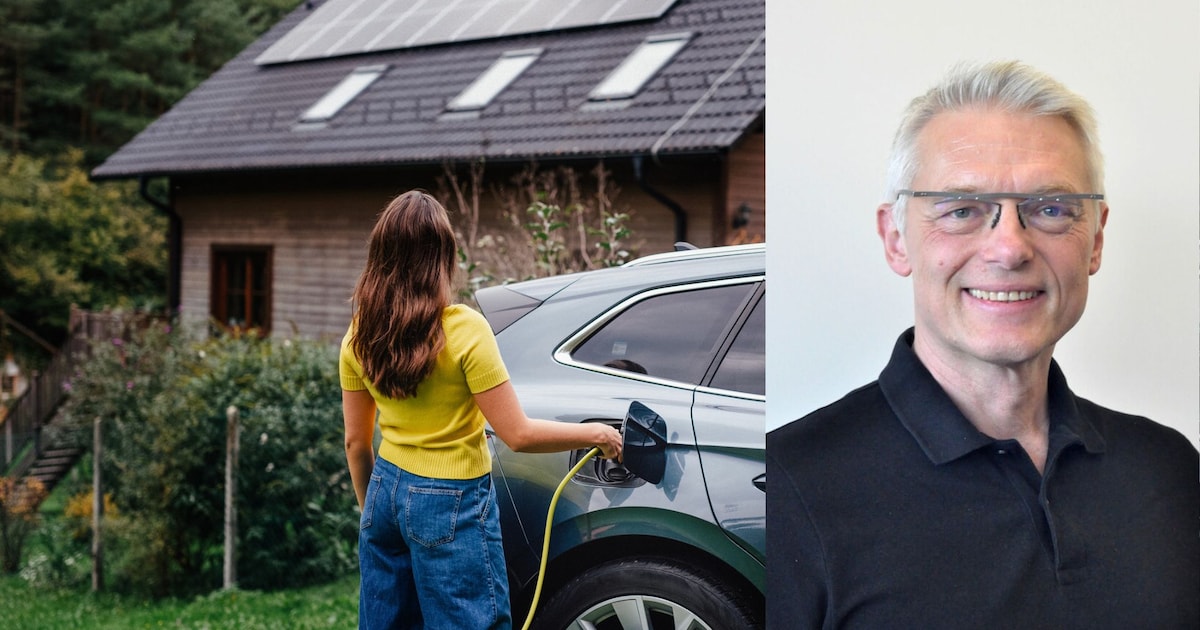
Drive an electric car completely for free? What sounds strange is actually already possible in practice today. Expert Andreas Varesi explains how this can work.
Two years ago, ex-Volkswagen boss Herbert Diess announced: “In the end, electric cars will be free and emission-free.” Last year at the IAA Mobility, the time had come when BMW and E.ON presented the first bi-directional charging tariff, which promised free charging power for up to 14,000 kilometers.
The basic idea is to charge the battery of an electric car with cheap electricity from the market and to feed this electricity back into the grid at a profit during a period of high prices. But can this really generate enough money to finance the traction current for a whole year?
From 2011 to 2014 I was sub-project manager for one of the first EU projects on bidirectional charging, the Smart Vehicle to Grid Interface (SmartV2G). Back then, our consortium had already succeeded in integrating electric cars into the public power grid as rolling energy storage devices, but free driving was out of the question at the time; a lot has happened since then.
Andreas Varesi is an e-mobility expert, owner of Varesi Consulting and the eMobile Academy. He advises companies on charging infrastructure, fleets and regulation and is involved in EU and AI projects. He is part of us EXPERTS Circle. The content represents his personal opinion based on his individual expertise.
How does electricity trading work?
First, we need to take a look at the basics of electricity trading. On the electricity exchange in Leipzig, electricity is traded, among other things, in the day-ahead market. “Day-ahead” means that prices are set today for every hour of the next day. Different feed-in capacities of renewable energies lead to significant price fluctuations in accordance with the law of supply and demand. At lunchtime, a surplus of photovoltaic electricity ensures low price phases.
In summer this even leads to negative electricity prices on some days. This means that anyone who buys electricity also gets paid something for it. Periods of high prices often occur in the evening hours when demand increases and solar production ceases.
Will the electric car become a money-printing machine?
At first glance it’s a money printing machine, but upon closer inspection the calculation is put into perspective. The average price spreads on the electricity exchange range from around minus 8 to minus 10 cents per kilowatt-hour in low price phases and between plus 8 and 12 cents in high price phases.
That sounds attractive at first, but it quickly becomes relativized when you take into account all the premiums that are added to the pure stock market price. These are network fees, levies, electricity tax, a concession fee and operating costs. In addition, you cannot simply trade on the Leipzig electricity exchange; you need an intermediary who also charges fees for this. In total, there is a surcharge of 12 to 14 cents per kilowatt hour.
And so it happens that even if the electricity market price is negative, you still have to pay something to purchase electricity. In addition, there are also up to 10 percent losses when charging and feeding it back in—energy that is wasted as heat and that you still have to pay for. So far, these factors have eaten up profits to such an extent that the investment in expensive, bidirectional wallboxes and control technology has not been worthwhile.
However, since the beginning of 2026, new legal regulations have been in effect as part of the energy industry law, which ensure that a large part of the above-mentioned surcharges are refunded (offset) for bidirectional charging.
Electric cars can stabilize power grids
And there is a second source of money for rolling electricity storage, which now makes the business model really attractive. Our electricity grids are only stable if as much electricity is consumed as is generated. Renewable energies are therefore a problem for grid stability because they provide electricity when the sun is shining and the wind is blowing and not when the grid needs it.
In order to counteract this, various forms of control energy are required, which serve exclusively to stabilize the network. Our rolling battery storage systems can provide one of these ideally, namely the so-called primary control power. No central control is required for this, but the charging stations can detect fluctuations in the network decentrally and fully automatically within seconds and counteract them accordingly by quickly feeding in or absorbing electricity. As an e-mobilist, you can participate in this balancing energy market via a so-called aggregator and achieve additional electricity price reductions.
How much money could I earn with an electric car today?
To get an idea of how much profit is possible with arbitrage trading alone, here is an example: Assuming that an electric car with a 75 kWh battery was connected to a wallbox around the clock in 2025 and used 80 percent of its capacity exclusively for electricity trading, it could have earned over 2,100 euros with 11 kWh of charging power. But since around 10 percent of losses occur during loading and unloading, only 1,700 euros could actually have been achieved.
The fact that a 10 percent charging loss leads to almost 20 percent less revenue is because the full electricity price including network fees is incurred for the loss. If the same car had been driven during the week between 8 a.m. and 7 p.m. and on the weekend between 10 a.m. and 6 p.m. and had only provided 65 percent of its capacity, the yield would be approximately 800 euros in 2025 been possible. The battery would have been subjected to twelve full charging cycles, which is negligible for a modern battery with a lifespan of over 2,000 charging cycles.
With a consumption of 18 kWh per 100 km and a household electricity price of 35 cents, the 800 euros correspond to a range of 12,700 kilometers. That’s more than the average mileage of a German car. In purely mathematical terms, it’s actually free.
All contributions by Andreas Varesi
Self-financing electric cars are not yet in sight for many people
Both income options, arbitrage trading and participation in the balancing energy market, can together ensure that our electric car can actually generate its own driving power. However, the prerequisite is that you have a vehicle and a charging station that can charge bidirectionally.
Then you still need an electricity supply contract with an aggregator that takes over exchange trading and participation in the balancing energy market. This is also the reason for corresponding combination offers consisting of an electric car, a suitable Bidi charging station and a contract with an energy supplier.
In addition, the vehicle must remain at a charging station for as many hours as possible. This cannot be achieved with public charging stations. In the foreseeable future, the topic of bidirectional charging will only play a role on private wallboxes and in company parking lots.
About the Author