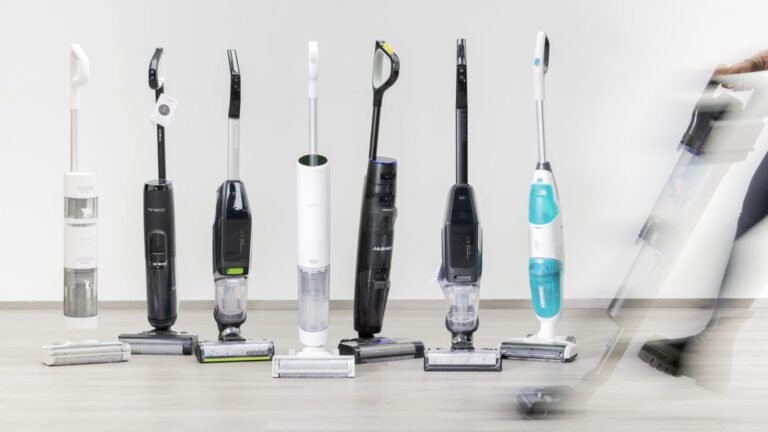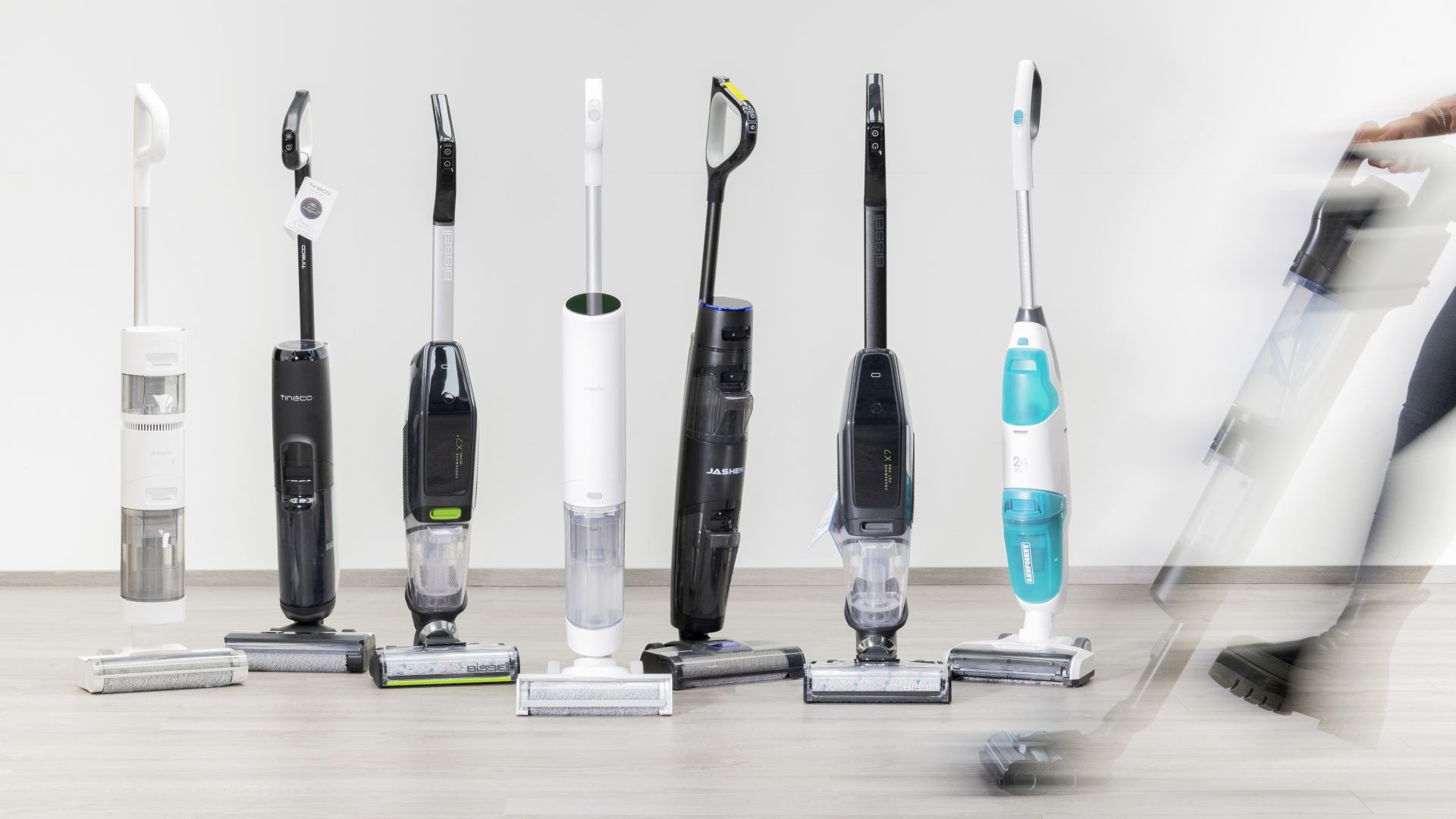
While we were developing this test procedure, we had to notice: vacuum mops are very difficult to test. On the one hand, this is due to the nature of combination devices. Unlike specialists like vacuum cleaners, we have to carry out many different performance measurements, repeat them and check our results. On the other hand, there is still no established standard format for vacuum cleaners and what they have to achieve in the different price ranges. There are sometimes big differences in how mopping devices actually work. Ultimately, we decided on the following categories and focus points:
Cleaning performance (40 percent): By far the most complex and important test is cleaning performance. For this category, we first check dust absorption. To do this, we distribute dust in separate measurements on a flat hard floor and in a 0.6 cm deep joint. We adapt the width of the measuring track and the amount of dust to the respective nozzle. We measure the weight of the dust container both before and after multiple passes with two pulls each. We then average at both minimum and maximum power levels. We do not check for carpets. Although it is generally possible to vacuum carpets with these devices, the nozzles of most models are not optimal for this. In this test procedure, we therefore concentrate on pure hard floor cleaning.
In the wiping tests, we differentiate between fresh and dried dirt. For the fresh stains, we spread a mixture of flour and water as well as a dab of honey over a flat joint in our test floor. Crusty cappuccino and honey stains are used for the dry tests. After each pull of the vacuum mop, we evaluate whether the dirt has been removed from both the hard floor and the joint. We also evaluate whether the devices have spread the dirt further – after all, it is undesirable if the mop scrapes the honey out of the joint but then spreads it further throughout the room.
In general, any vacuum mop can be used without cleaning agents. Because it cannot be ruled out that universal cleaning agents will cause damage to a device or are unsuitable for sensitive floors, we have refrained from using them. However, if a cleaning agent is included as standard with a vacuum mop, we used it for our wiping tests.
Handling (25 percent): You also want to use a vacuum mop – that’s why this category has the second most points. Everything you need when using it flows here. The subjective evaluations include the complexity of operation, the maneuverability, how the device can be converted and how hygienically it can be cleaned. We also measure the weight during use with a luggage scale and evaluate other practical features – such as an automatic mode, a battery level percentage in real time or clear error messages.
Battery (20 percent): The third most points are attributed to the battery rating. We measure the running time of the devices exclusively in the combined suction-mopping mode, both at minimum and maximum power. If several batteries are included, we add up their running times – with a small time penalty, because two bad batteries shouldn’t be worth as much as one good one. For this test, we angle the devices as in real use, place the nozzle on the hard floor and let it run empty. We also had to tie some of them down because some of the nozzles served as propulsion and wanted to drive away with the vacuum cleaner. We also measured the charging time of all batteries for each device.
Equipment (15 percent): Lastly, we evaluate everything that comes in the pack. This includes the mentioned replaceable batteries, nozzle lighting, additional nozzles and other accessories. A cleaning station was very important for us: all the comfortable wiping fun quickly turns into the opposite when you have to pull the wiping brush out of the nozzle and wring it out. It’s also not much fun to disassemble the vacuum mop and lay the parts out individually in the sun to dry. Bonus points for a water heater and drying functions.
About the Author