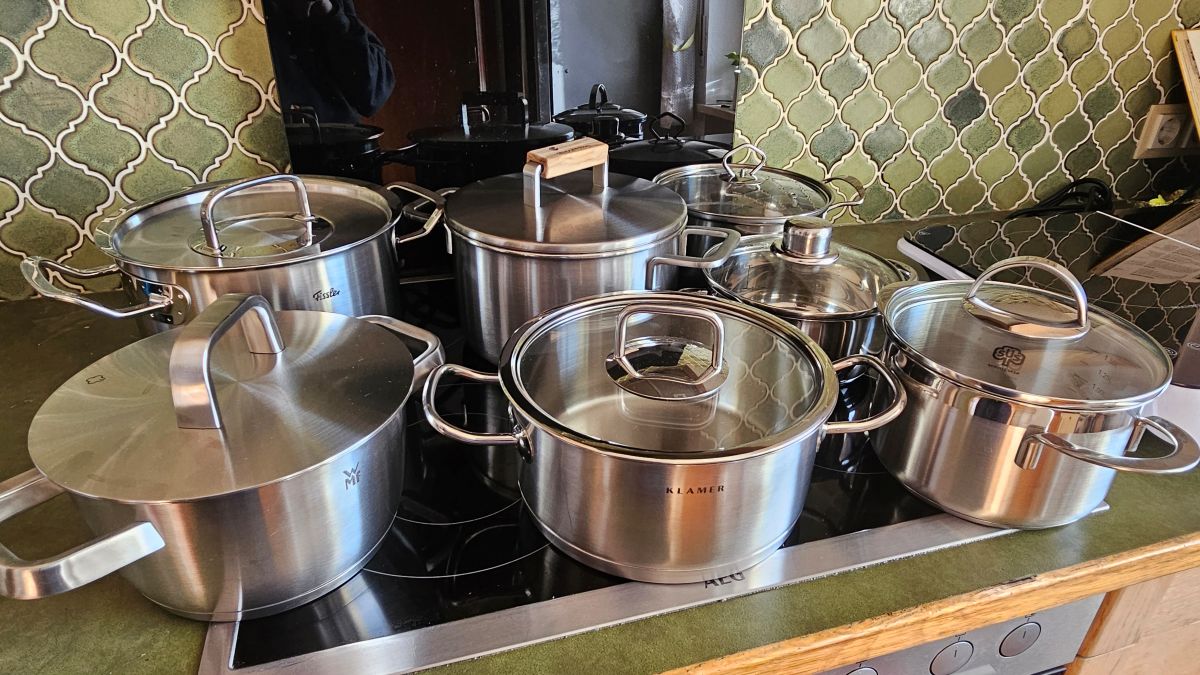
For the practical test, our tester cooked with the pots in her kitchen for five weeks and evaluated handling, functionality, workmanship and suitability for everyday use. For the test table, we took into account the values of the largest pot (24 centimeters) and smallest pot (16 centimeters). We did not include pans and milk pans. If there was only an 18 centimeter pot as the smallest size in a set, we evaluated this for the test.
To handling (20 percent) what counted for us was ergonomics and comfort: How heavy are the pots empty and with 2 liters of water? Can the pot still be lifted easily? Is there a shelf for the wooden spoon or a liter scale? Did the manufacturer think of a pouring aid? Do the lids rattle when cooking or does so much steam escape from the sides that it splashes all over the stove?
We already have them before cooking stability of the pots evaluated (10 percent). Is the base lying flat on the stovetop so that the heat can be distributed evenly? Or does it wobble back and forth?
At the Functional test (50 percent), we assessed how long the pots needed for 1 liter of cold water straight from the tap (18.9 °C) until it actually boiled. We set the stovetop (ceramic or induction) to the highest level and closed the pot lid.
We also wanted to know how long it took for the water to cool down from 100 °C to 65 °C. To do this, we recorded the temperature progression using a conventional cooking thermometer.
Another important thing for us during the functional test was whether the handles could still be touched. Or whether they heat up too much (thermal imaging camera).
In addition to the cooking time, we tested the heat distribution at the bottom of the pot. To do this, we sprinkled a thin layer of flour (approx. 1 mm) onto the cold, dry bottom of each pot using a sieve and heated the pot over a medium heat without stirring. If the flour is evenly light brown almost everywhere, the heat distribution is good. On the other hand, if there were strong brown rings in the middle or at the edge and white spots in between, we considered these to be hotspots and therefore uneven heat distribution. Of course, we took small piles of flour into account during the test. We did not rate these mostly bright areas negatively.
In the end we wanted to know more about them Suitability for everyday use know (shelf life 20 percent). Because this is a practical test, we didn’t do any laboratory tests, but rather looked at how the pots behave in the dishwasher. Each pot and each lid were washed 50 times in the dishwasher at 70 °C. We then evaluated:
- Whether the stainless steel is visibly discolored.
- Whether there is rust or corrosion on handles, rivets or screws.
- And whether screws, handles or lid fasteners have become loose.
We then gave pots that survived this washing marathon without any injuries a higher rating. We also checked whether it was suitable for the oven. To do this, we filled the pot with 2 liters of cold water and placed it in the oven at 200 degrees for 1.5 hours. We have devalued any deformation or discoloration.
About the Author