[ad_1]

Even people who are completely unfamiliar with technology can test the condition of their electric car battery: The Aviloo Premium test is very easy to carry out, as our practical test shows. This starts with the order, specifying the vehicle type, plugging the device into the OBD-II port and completing the test. The certificate clearly provides the information you need as a seller or buyer of a used electric vehicle. At 99 euros, the test is not cheap, but it is a good investment. There is currently no real alternative.
How good is the battery after years of use? Buyers of used electric cars ask themselves this question, as do owners who want to sell their electric car. Only a battery with the highest possible remaining capacity will provide a good range and, more importantly, give hope for a long car life. Electric cars that only manage half of their original range are impractical and a purchase risk. The Aviloo test from the Austrian provider of the same name promises to quickly carry out a battery health test.
What is the Aviloo Premium test?
The premium version of Aviloo is aimed at individuals who want to find out how much of the original battery capacity is left. Unlike some purely app-based alternatives such as ClearWatt, Aviloo uses a diagnostic device that is sent after the order is placed. While driving, this device logs the battery data via the OBD port (onboard diagnosis) in the car. After the test, the device is returned to Aviloo and after a few days a certificate with the confirmed state of health (SoH) data of the e-car battery arrives in the email inbox.
The Aviloo test is an important selling point on the used electric car market. In many sales advertisements you will find the note “With battery certificate”. Important: The Aviloo Premium is a comprehensive battery test, while the simpler (and cheaper) Aviloo Flash is a quick test that provides an assessment of the SoH in a few minutes while stationary via OBD data reading, but does not analyze as deeply as the Premium test. The flash test cannot detect faulty individual battery modules as clearly as the premium test.
An interim conclusion: The Aviloo Premium is currently probably the most thorough battery test and therefore an important tool for buyers and sellers.

This is how the Aviloo Premium test works
The procedure is clear:
- The order is made via the Aviloo website and costs 99 euros including shipping and returns.
- After a few days you will receive the device in the mail from Austria.
- After you have charged your electric car to 100%, connect the device to the OBD interface and start the test via the website on your cell phone.
- The device takes measurements while you drive your electric car to a battery level of less than 10 percent. You don’t have to do this in one go, you can do it several times as normal. The only requirement: The battery level must be below 10 percent within ten days.
- Aviloo informs you via the website that the test is now complete. You remove the device and send it back.
- After a few days you will receive the signed certificate as a PDF by email.

Aviloo Premium test in practice
In fact, the test runs without any problems in practice. After placing the order with the details of our test car in January 2026, it takes about a week until we receive a well-packaged blue suitcase from Austria. Inside you will find the device with simple instructions.
We log in via the Aviloo website and are asked to plug the device into the OBD interface. If you don’t know what this is and where this connection is located, you will receive help immediately. Aviloo knows which electric car you want to test based on your order. In our e-Up, built in December 2021, – as in most cars – the OBD-II port is located in the interior under the dashboard on the driver’s side above the pedals.
After we have fully charged our e-Up, we plug the Aviloo measuring device cable into the port – a process that literally only takes a few seconds. After a short while, the website informs us that the test is now starting and that we should drive the car to less than 10%. No sooner said than done: We take the connected device with us on our everyday trips for four days at temperatures around freezing point. The cable is hardly a problem, we just have to be careful not to get caught on it when getting out of the car. Since the cable is long enough, we store the device itself under the driver’s seat. On the cell phone we find out via the Aviloo web app that the measurement is running and how low the battery level is now. When we get below 10 percent, there is the green light to end the test. We drive a little further, at the end we park the car at 6 percent remaining battery and inform Aviloo via the web application that we are now ending the test. Then we pull the plug out of the OBD-II port. The web app registers this and promises to send us a certificate shortly. We can also now return the device.
Thanks to the return label included in the package, shipping is completed quickly and costs us nothing. The easiest way to do this is to use a DHL packing station.
Interim conclusion: Fortunately, the premium test really works as simply as Aviloo describes it on its website. The instructions and the precise explanation for your own car are designed to be idiot-proof. In our opinion, the test is feasible for every car owner.
Less than 24 hours later we received an email saying “Congratulations on the successful Aviloo Premium test”. Curious, we open the certificate: How good is our four-year-old battery in the VW e-Up? Are there any other insights?
The Aviloo battery certificate: Breathe a sigh of relief with the SoH
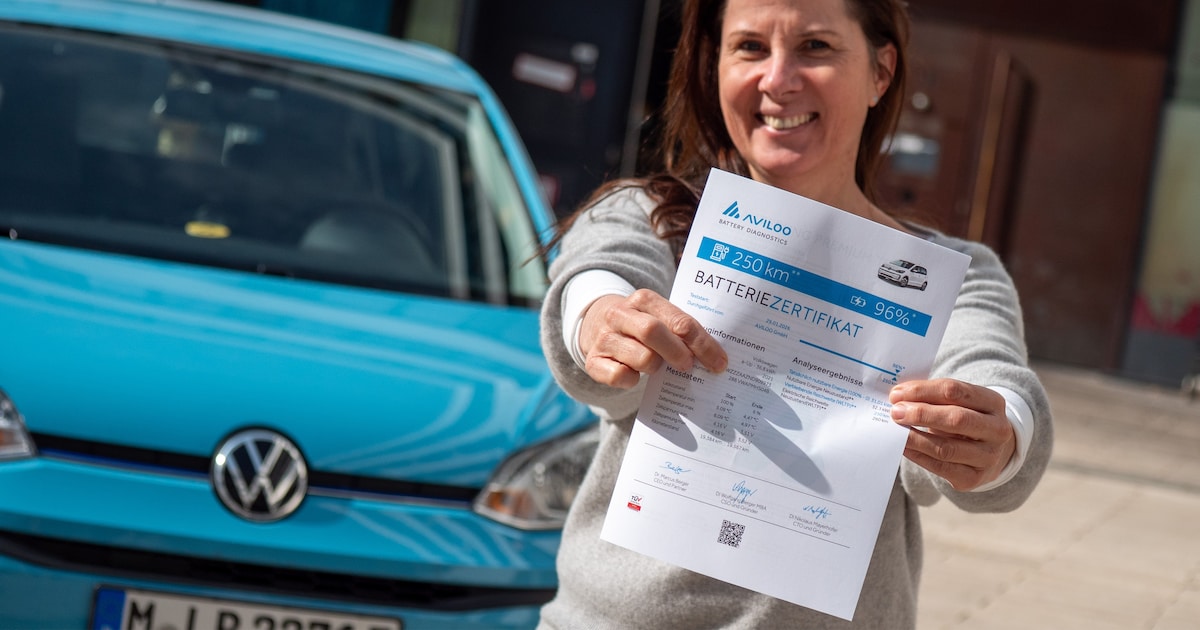
The certificate is the best proof of how slowly electric car batteries age: our four-year-old VW e-Up has a whopping 96% remaining capacity. The certificate certifies that we have a range of 250 kilometers. This corresponds to our feeling: in winter it is almost 200 kilometers, in summer we can still sometimes travel 300 kilometers.
In addition, the certificate shows us that we can still use 31 kWh of the gross 36 kWh. When new it was 32.3 kWh. So in four years we have lost just 10 kilometers of range. To be fair, it has to be said that our test car only has just under 20,000 kilometers on the clock. During the four years, we roughly estimated that we charged 80 percent using our home AC wallbox and 20 percent using DC fast chargers. We didn’t always stick to the maximum 80% charging recommendation. The car also sat around for a few days with the battery full to the brim – a deadly sin in the opinion of battery experts.
Despite the low mileage, we are pleasantly surprised by the high remaining capacity: it means that the battery should last for many years to come.
The certificate shows important information for the sale such as the VIN, the year of manufacture and the mileage. You will also find out measurement data such as minimum and maximum cell temperature and cell voltage. The certificate also features three signatures from the Aviloo bosses.
Conclusion of the test: Simple, reliable and informative
Even without technical knowledge, the Aviloo PREMIUM test is easy to carry out – from ordering to plugging it into the OBD-II port. For 99 euros it provides a clear certificate of battery condition and there is currently practically no alternative. The battery check offered by ADAC, for example, also uses the Aviloo service.
E-car funding: amount of the premium, income limits, calculator
[ad_2]
About the Author