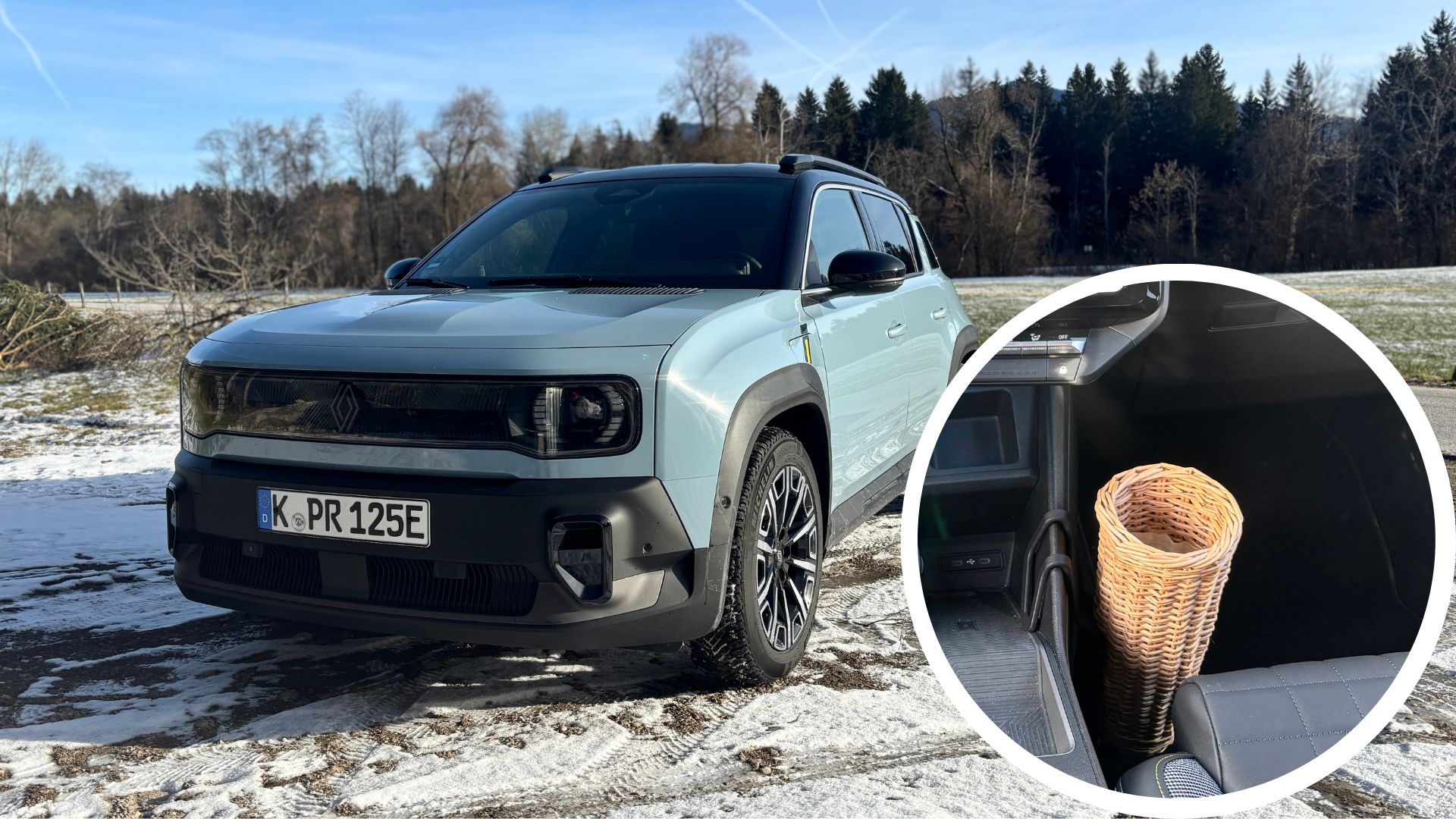
In our latitudes, an electric car must also be suitable for winter. Admittedly, temperatures of minus 18 degrees, like the ones we had in Bavaria after Christmas, are exceptions in our car tests. In order to keep the consumption fair with other cars that we test in the summer, for example, we always subtract the heating consumption from the total consumption.
But even if the heating in the R4 works well and consumes moderate electricity, the Frenchman is not the most comfortable car in low temperatures. It starts with a two-stage seat heating, which even at the higher level has a hard time getting the seat really warm.
It continues with a steering wheel heating that doesn’t stay constantly warm while driving: sometimes the steering wheel gets nice and warm, then it cools down again.
A window heater with heating wires is ideal for icy windshields. It is nowhere near as power-hungry as the usual blower. But this practical window heating is missing in the R4—as in other electric cars from the French manufacturer. However, Renault is not alone in this; many other manufacturers are also foregoing this important winter gadget.
Every battery in an electric car only charges optimally when it reaches the correct operating temperature—this is especially true for fast charging beyond the slow 11 kW AC charging. To ensure optimal charging performance at the fast charging station, electric cars have the preconditioning function.
In electric vehicles, you can often at least start the preconditioning manually via the infotainment system or even set it so that the battery is already warmed up before you set off the next morning so that you can get good charging performance after just a short drive to the next charging station. Or you can start the preconditioning via the app via remote control.
But none of that works with the R4. In order to precondition the battery, you must first select a DC charging station as the destination in the Google navigation. It shouldn’t be too close, as the battery cannot warm up as quickly in cold temperatures. Renault recommends a minimum 30-minute drive.
This can be annoying; after all, you should plan for this procedure and the time when you need fast charging, especially in winter when the battery is empty. In the worst case, you’ll be like us in the test: At minus 5 degrees, a DC fast charging station only had 9 kW of charging power, with the battery not yet at the right temperature.
About the Author