[ad_1]

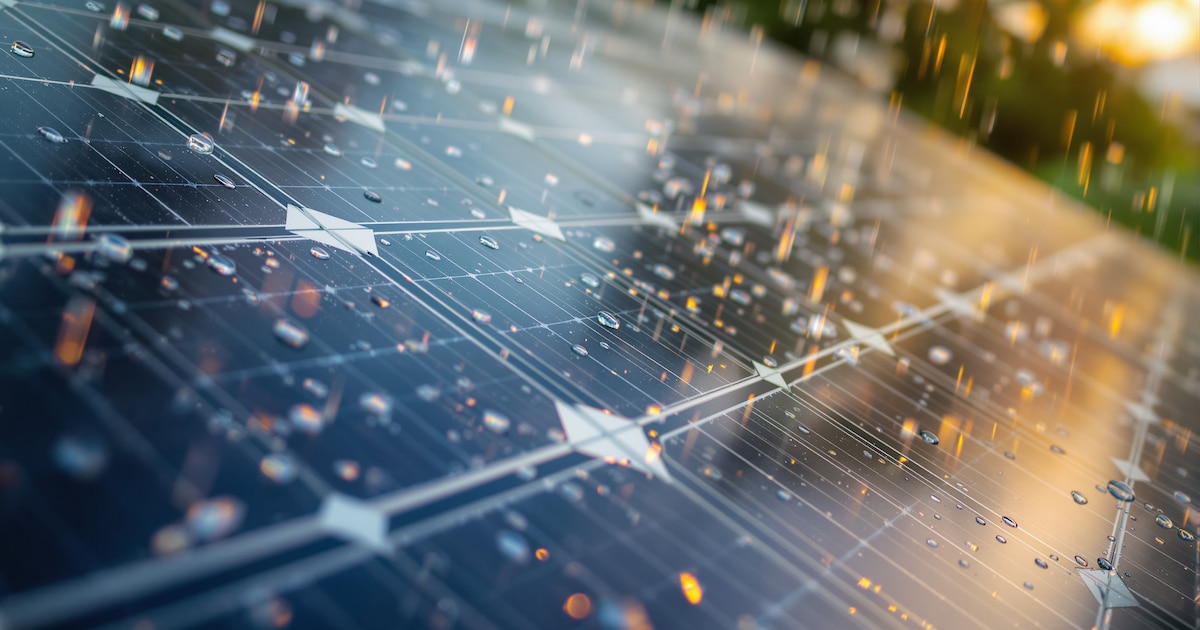
When it rains or storms, solar panels produce little to no electricity. At least that’s how it was so far. A Spanish research team has now built a solar cell that can also generate electricity from rainstorms.
Spanish researchers have developed a solar cell that generates electricity even when it rains. They achieved this by developing a special coating. They recently received the results of their research published in the journal Nano Energy.
Electricity from rain: Most people know this effect from their childhood
The team led by first author Fernando Núñez-Gálvez from the Institute of Materials Science in Seville (ICMS) says they have built the first solar cell that can also generate electricity in the rain. It is not unknown that electricity can be generated from falling raindrops. However, the combination with photovoltaics is extremely remarkable, as is that Trade magazine ingenieur.de reports.
The energy comes from triboelectric nanogenerators (TENG), which make use of a principle that most people know from childhood: two materials with different conductivities exchange electrons upon contact and statically charge each other. When the contact is separated, voltage is created which can be dissipated as current via electrodes.
The same phenomenon occurs when you rub a balloon on your clothing. The resulting tension makes your hair stand on end as the balloon approaches.

Coating is a thousand times thinner than a human hair
The researchers from Seville are now taking advantage of this effect by developing an ultra-thin and transparent coating for solar cells that converts the voltage from impacting raindrops into electricity. It is similar to the chemical structure of Teflon and is between 100 and 130 nanometers thick. For comparison: a human hair is usually around 1,000 times as thick.
Using plasma-protected vapor deposition, the researchers apply the material to the cell at room temperature. It has the advantage that no solvent can damage the sensitive cells.
Once on the cell, the layer fulfills other functions in addition to producing triboelectric electricity: it protects the cell from moisture and temperature fluctuations, increases light transmission and reflects UV radiation, which can cause damage.
chip newsletter
CHIP ePower newsletter
Once a week everything about the best e-cars, e-bikes and heat pumps as well as the best sources of electricity: green electricity providers, balcony power plants and solar systems. We will guide you through the energy transition with tests, guides and purchasing advice.
Cell efficiency suffers due to the coating
In a practical test in the Andalusian rain, the nanogenerator was able to demonstrate a power density of four milliwatts per square centimeter of module area. That would be an impressive 40 watts per square meter, i.e. almost a fifth of the usual solar output. However, the lifespan of the coating is a problem: after 17,000 impact drops, the generator still had 85 percent of its original output. 17,000 drops per square centimeter may correspond to several years’ worth of rain. However, PV modules last for over 25 years.
The efficiency of the perovskite cell also suffers from the additional coating. Ideally, it was four percentage points below the normal efficiency of comparable cells, around 22 percent. The best result delivered an efficiency of 17.9 percent. The reduced yield therefore eats up some of the energy gained through the coating.
Technology should primarily be used in the Internet of Things
In the specific application test, a hybrid system illuminated two rows of LEDs. The photovoltaic energy caused red lights to turn on, and when it rained, green diodes also lit up. The research is still in its infancy, but in the long term the Spaniards see opportunities to power small sensors in all kinds of smart systems. Nuñez-Gálvez says: “Use in so-called smart cities is realistic, for example in signage, autonomous auxiliary lighting or monitoring, as the system can withstand adverse weather conditions, rain, humidity and thermal cycles. It could also be used for distributed energy structures in remote, difficult to access or isolated areas, such as marine stations.”
It therefore does not seem impossible that the home’s rooftop solar system will one day generate electricity during a thunderstorm, although it is not likely for the time being given the reduced yields.
More about new solar technologies
[ad_2]
About the Author