[ad_1]

Cardboard drinking straws have been around for a while, and for many it remains a nuisance. Others think that the world can be saved to some extent.
It’s become a running gag on the Internet for a few years now: While super-rich people fly over in private jets to the west wing of their mega-property, the common mob has to fight against environmental pollution with cardboard straws.
Because this is supposed to save the world to some extent. For many consumers, this feels cynical and absurd. Even in connection with the war in Iran came the straw meme so recently up again.
In principle, small changes on a global scale can actually make big changes. But that would assume that the properties of the alternative are actually better.
Although that’s not the case, we’ve had to deal with soggy rolls in our drinks for over five years. That can’t be the generally accepted solution, can it?
Single-use plastic products have been banned in the European Union since mid-2021. So, not all, but only certain onesincluding cotton swabs, cutlery or plates.
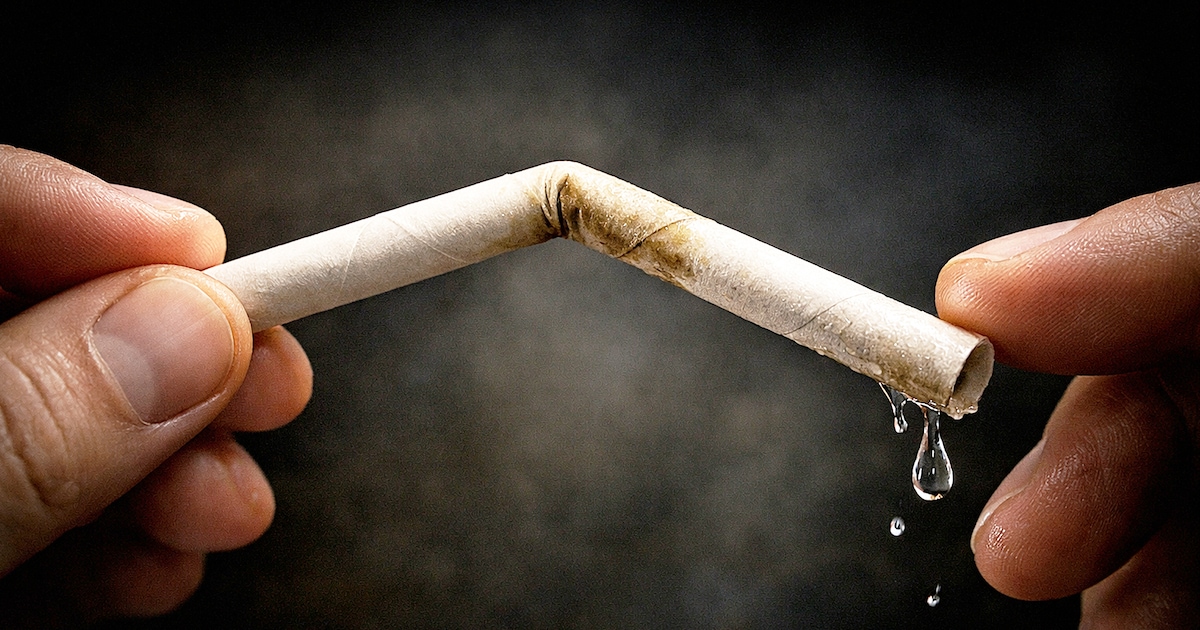
However, there was no other product as much turmoil as the straws. This is probably because the alternative is simply unsuitable for its intended use: sooner or later the material softens, both at the bottom of the drink and at the top where the mouth moistens it.
Not only does it look unappetizing, but it also feels disgusting. This often happens, especially with drinks like cocktails that you like to sip on for a while. Some consumers even report that the taste of the drink changes as a result.
With carbonated soft drinks it can also happen that suddenly foam overwhen they come into contact with a cardboard straw. This is demonstrated by Hannah Fry, professor at University College London, in a short video.
Similar to the well-known Mentos Cola experiment, the comparatively rough surface of the drinking straw offers numerous “nucleation points”, i.e. places where the carbon dioxide can (to put it bluntly) react. Not only can this be messy, but it can also make the drink stale more quickly.
And those are just the problems that consumers directly observe themselves can. Scientific studies in recent years show a much darker side of the coin.
Cardboard straws have these invisible problems

The North Rhine-Westphalia consumer center has some investigations compiled by various scientists who highlight the problems with cardboard straws. The results in a nutshell (excerpt):
- Chemical Veterinary Examination Office Stuttgart: According to the 2019 study, 6 out of 13 cardboard drinking straws tested contained carcinogenic chloropropanols in quantities above the guideline value of the Federal Institute for Risk Assessment (BfR). A year later, out of 108 samples, only six were found to be abnormal.
- Study from Belgium: In 2023, 39 drinking straws made of cardboard, bamboo, glass, stainless steel and plastic were tested for PFAS, so-called forever chemicals. Except for stainless steel products, these occurred everywhere. This means that cardboard drinking straws are supposed to repel liquids better and therefore soften less quickly.
- Investigation from Spain: In 2024, chemical transfer from printed cardboard straws to sparkling water was investigated. Included “Photoinitiators, a dye, a carcinogenic aromatic amine and phthalate plasticizers that damage the endocrine system were detected”says the consumer advice center.
You can do that scary PFAS foam also on German coasts watch – you shouldn’t touch it. Are invisible eternity chemicals now better for the world’s oceans than plastic straws? It’s a choice between plague or cholera.
Of course: Nobody is forcing you to use the cardboard tubes. But what is the best solution to the straw problem? The North Rhine-Westphalia consumer advice center has a clear verdict on this:
“In most cases, drinking straws are simply unnecessary.”
So the best solution is to prevent disposable waste from being created in the first place. This applies to both plastic and the annoying cardboard tubes, because they are not resource-efficient either. If you can’t do without the sucking feeling, you should use long-lasting solutions.
The reusable, flushable versions made of glass or stainless steel are best. If you generally don’t want to receive a cardboard straw in a café or restaurant, you should point this out before ordering – this way you can avoid waste.
I use it myself at home rustproof stainless steel strawsalthough cleaning is a little more complicated. The inside should be cleaned with a small brush after the rinse cycle, but this is usually included. The parts then last a lifetime.
What remains of this story is the myth of the personal CO₂ footprintwhich shifts responsibility from legislators and large corporations to consumers. Consumers who are often concerned with the question of whether there will be enough money left at the end of the month for the essential things in life. Is that fair?
[ad_2]
About the Author