[ad_1]
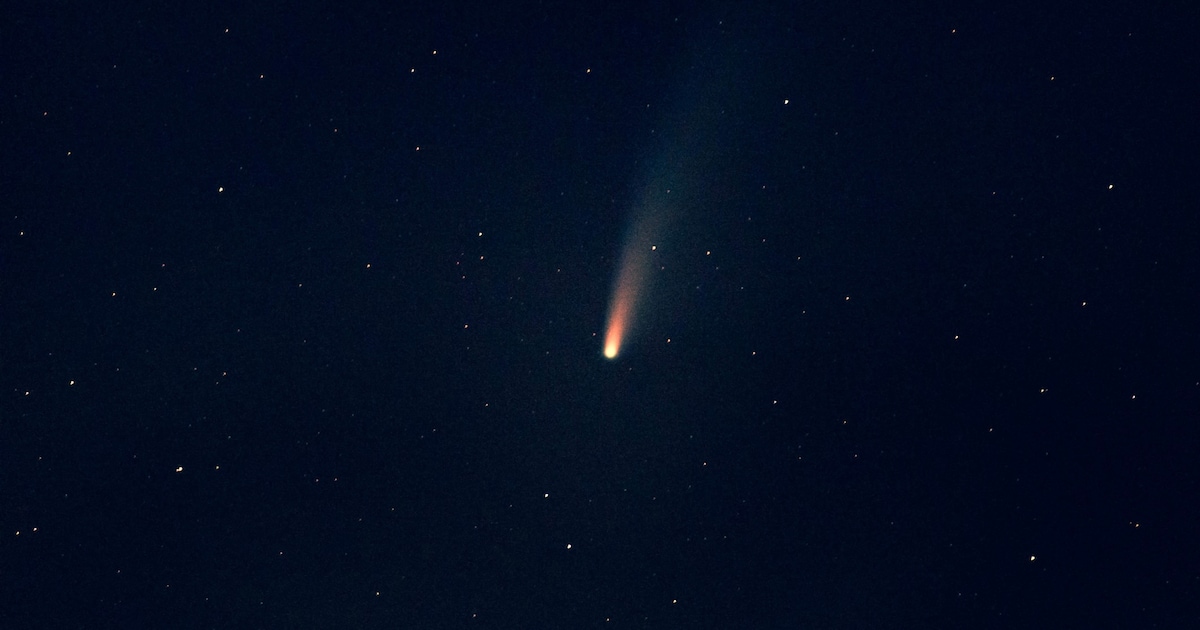
A stone falls from the sky, possibly lands in a field and suddenly a very earthly question arises: Who actually owns such a meteorite? The answer in Germany is more complicated than many people think.
On Sunday evening there was one bright meteorite over West Germany sighted, which led to a large number of reports to the police in Lower Saxony. If a meteorite actually hits the ground, the question quickly arises: Who does it actually belong to and can I just take a stone with me?
Federal states set rules
In principle, the rule of thumb “the finder gets to keep” often applies. This can apply, for example, if a meteorite lands on public property or on your own property and no other law applies. But it’s not quite that simple. In Germany, the federal states sometimes regulate such finds differently. What is particularly important is whether there is a particular scientific interest.
Then the piece of heaven can quickly become state property. In such cases, in some countries a so-called treasure shelf or a similar special regulation in monument protection law applies. This means that the finder does not automatically get the stone, but rather the land can become the owner. The finder usually doesn’t come away completely empty-handed, but is more entitled to a reward than to the meteorite itself.
chip newsletter
CHIP Household & Garden
Once a week we tell you the best household tricks, what work needs to be done in the garden and what mistakes you should avoid.
What is such a meteorite even worth?
Of course, the topic also sounds financially exciting for collectors. And in fact, meteorites can fetch very different prices. According to Stephan Decker from the Meteorite Museum in Oberwesel, quoted by SWR, the range ranges from around one euro per gram to up to 5,000 euros per gram.
Whether a find is in the lower or upper range depends on several factors. What is important are the composition, the state of preservation and the question of whether the stone was recently fallen or has been on the ground for a long time. Rarity also plays a big role. In case of doubt, an inconspicuous chunk can be worth more than you think – but it doesn’t have to be.
For amateur searchers, this is tempting but risky. If you find a suspicious stone, you shouldn’t rush to sell it online. Reporting requirements can apply, especially if there is a scientifically rare meteorite. Otherwise, in the worst case scenario, there is a risk of legal problems.
And what about damage – does the insurance pay?
Another question that is even more practical for many homeowners is: What happens if something like this hits and breaks something? There is no simple standard answer here either.
Pure debris damage caused by meteorites is often not automatically covered by residential building or contents insurance. According to the insurance industry, there is no uniform regulation. So it really depends on the specific contract.
Things look a little better if the impact causes a fire or explosion. Such consequences are usually insured in many policies – regardless of what caused the fire. Natural hazard insurance or so-called all-risk coverage can also help in individual cases. But consumers should really look at the small print here.
It is also important to note that a meteorite is not legally considered an unmanned missile. Anyone hoping that a corresponding clause in the insurance contract will apply could be disappointed. Because meteorites are of natural origin – unlike drones or satellites, for example.
[ad_2]
About the Author