[ad_1]

Google has activated the new “Android Desktop Mode” on current Pixel devices via an update. The mode will soon be available on other cell phones – but how well does it perform in practice?
Smartphone processors have long since offered enough performance to take on everyday PC tasks. Apple recently even released a new one Macbook with iPhone processor presented. Full cell phone power in notebook format.
But there’s an easier way: Google has been working on a fully-fledged desktop mode for Android for a long time. With the current Android 16 QPR3 update (“March Pixel Drop”), this can now also be used without a beta version for the first time.
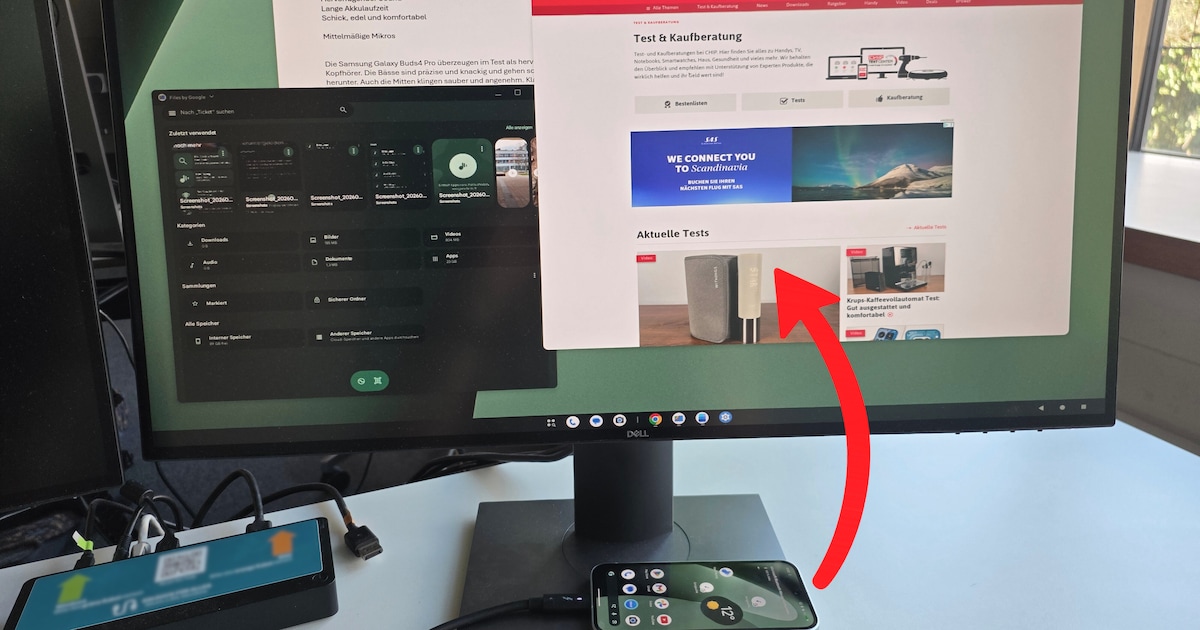
Owner of one Google Pixel 8 (test) or newer, or a Pixel tablet, you can easily connect the device to supported monitors via USB-C. Android then expands the display into a full desktop interface. Windows, taskbar, mouse control, etc. included.

Pixel desktop with pixel resolution
We have the mode with one Google Pixel 10a (test)mouse and keyboard tested. The connection already presented us with some challenges. The display resolution was initially very low and the interface appeared strangely scaled. A few times the Pixel 10a even froze and had to restart. After a few attempts it finally worked.
The Window management works smoothly. Windows users in particular will feel right at home: There is a start menu and the window bars come with classic minimize, maximize and close buttons. The “Snap” function for docking windows to the edges of the screen also works as usual. You quickly forget that you are actually still using an Android phone.
By the way, technically this is where the “Jetpack WindowManager 1.5.0” is used. It ensures that the apps are scaled appropriately and adapt adaptively to different screen sizes.
The Operating speed is also pleasingly fast and without any annoying jerks. If you rely primarily on Google’s own apps such as Docs or Chrome, you can work productively. Things are less smooth with third-party apps: for example Microsoft’s Word app Even simple actions like selecting text with the mouse are not yet possible. Here it is up to the developers to optimize their apps for the new desktop mode. We also noticed that keyboard entries were recognized with a slight delay in some places. The Android desktop mode did not yet offer a really stable experience for us.
Samsung has long been offering “Dex,” a desktop mode for its Galaxy devices that also works wirelessly. In a direct comparison, Samsung’s solution appears more sophisticated and suitable for everyday use. We particularly miss the option of using the Galaxy phone’s display as a touchpad for mouse control on the Pixel. The smartphone lies around here with a glowing screen, rather useless. If you turn off the display, you also darken the monitor.
Google’s desktop expansion
The Google Pixel Tablet can also use desktop mode directly on its own display without a connected display – similar to what Apple introduced with iPadOS 26.
Regardless of the new desktop mode, Google is planning under the name “Aluminum OS” a completely new desktop operating system based on Android. In the long term, the aim is to replace Chrome OS and offer competition to Windows.
[ad_2]
About the Author